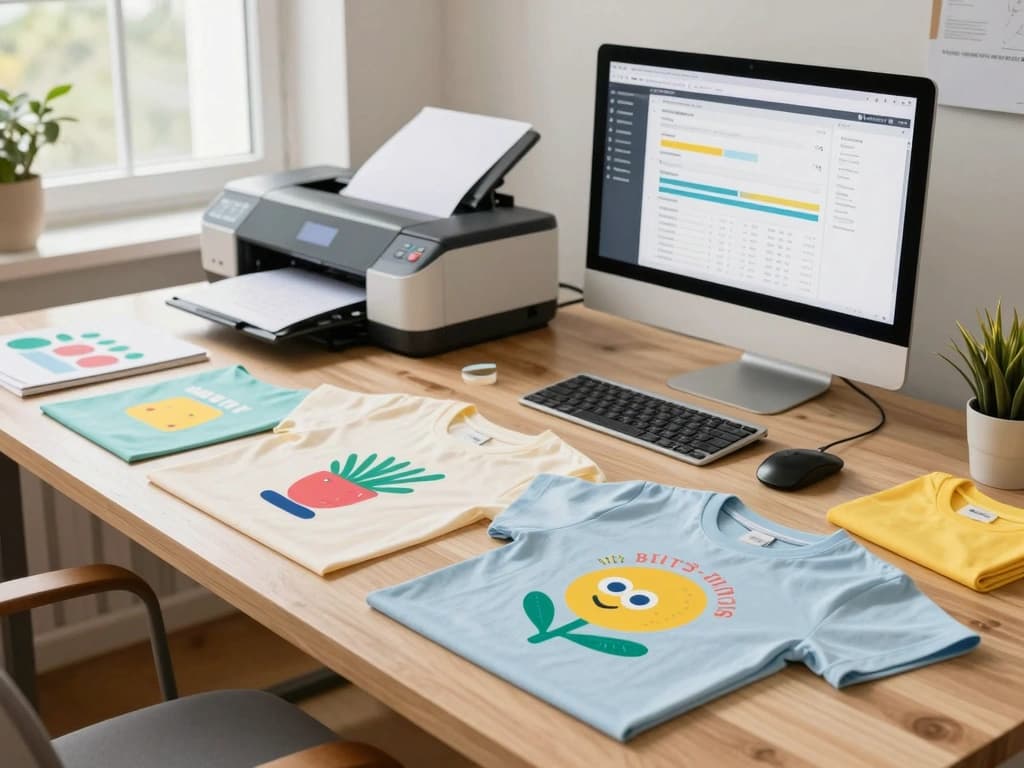
Discover the essential print-on-demand t-shirt margin breakdown to maximize your profits. Learn pricing strategies and tips for successful ecommerce shopping.
Understanding Base Costs of Print-On-Demand T-Shirts
Print-on-demand (POD) t-shirts have created a significant opportunity for entrepreneurs looking to enter the ecommerce space without the burden of managing inventory. However, understanding the costs involved is crucial for establishing profitable operations. This section delves into the base costs associated with print-on-demand t-shirts and the various factors influencing these costs.
Factors Influencing Base Costs
The base cost of a print-on-demand t-shirt comprises several components. Here are the primary factors influencing these base costs:
- Material Quality: The fabric quality plays a significant role in determining the base price. For instance, a basic cotton t-shirt might cost around $10, while a premium tri-blend t-shirt can reach $18 or more.
- Printing Method: Different printing techniques (such as screen printing, direct-to-garment (DTG), or sublimation) have distinct cost implications. DTG printing typically incurs higher costs due to its detailed and high-quality output, often adding an extra $5 to $10 to the base price.
- Customization Options: Additional features like all-over prints or specialty inks increase production costs. For example, an all-over print t-shirt can cost $25 compared to a standard print at $15.
- Volume: Bulk orders can significantly reduce per-unit costs. Many POD providers offer discounts for larger quantities, lowering the base cost when ordering in bulk.
Comparing Different Print-On-Demand Providers
Not all print-on-demand providers offer the same pricing structure. Below are comparisons of popular POD services:
- Printful: The base price for a basic t-shirt is around $12, with additional costs for printing and shipping. They are known for high-quality prints but may be pricier compared to others.
- Teespring: The base cost is typically lower, around $10, but the quality may vary. They focus on user-friendly design interfaces and marketing tools.
- Redbubble: Offers unique artist-driven designs but at a higher base cost of approximately $15. The platform takes care of marketing, which can justify the price.
By comparing different providers, sellers can find the one that balances quality and cost to fit their business model.
Quality vs. Cost: Finding the Right Balance
Striking the right balance between quality and cost is essential. Selling low-quality t-shirts may lead to negative reviews and reduced customer loyalty, while overly expensive products may deter potential buyers. For example, a seller might choose to use a standard cotton t-shirt from Printful at $12, knowing that the quality will satisfy most customers, versus opting for a premium option that could push the retail price beyond what customers are willing to pay.
To find this balance, sellers should consider their target audience, pricing strategy, and brand positioning. Testing different products with a small marketing push can help gauge customer reactions before committing to larger orders.
Calculating Selling Price for Maximum Profit
Once the base cost is established, the next step is to calculate the selling price to ensure maximum profit margins. This involves not only covering costs but also appealing to customers' purchasing behavior.
How to Set Your Selling Price
Setting the selling price involves understanding both the base cost and desired profit margins. Here’s a simple formula:
Selling Price = Base Cost + (Base Cost * Desired Profit Margin)
For instance, if the base cost of a t-shirt is $12 and you want a profit margin of 50%, the selling price would be:
$$12 + ($12 * 0.50) = $18
This formula helps ensure that all costs are covered while also considering the profit margin.
Psychological Pricing Strategies
Psychological pricing strategies can also influence how customers perceive value. The most common approach is setting the price just below a round number, such as $19.99 instead of $20. This small difference can significantly impact buying decisions and can be effective in increasing sales.
Another strategy is bundling products to create perceived value. For example, offering a discount when purchasing two t-shirts can entice customers to spend more while feeling like they are getting a deal.
Assessing Market Demand and Competitor Pricing
Understanding market demand and competitor pricing is crucial for setting competitive prices. Tools like Google Trends can help gauge interest in specific designs or styles over time.
Additionally, analyzing competitors provides insights into pricing strategies. If competitors are selling similar t-shirts for $20, pricing your t-shirts at $19.50 could make your offering more attractive without significantly compromising your margin.
Analyzing Profit Margins in Print-On-Demand
Profit margins are critical metrics in determining the financial health of a print-on-demand t-shirt business. Understanding the difference between gross and net margins can provide a comprehensive view of profitability.
Understanding Gross vs. Net Margins
Gross margin refers to the revenue remaining after deducting the cost of goods sold (COGS). It is calculated as:
Gross Margin = (Selling Price - COGS) / Selling Price
If you sell a t-shirt for $20 with a base cost of $12, the gross margin would be:
$$20 - $12 = $8; \text{ thus, Gross Margin} = \frac{8}{20} = 0.40 \text{ or } 40\%
Net margin, on the other hand, accounts for all expenses, including shipping, marketing, and operational costs. Understanding both metrics helps sellers assess the overall profitability of their business.
Impact of Discounts and Promotions on Margins
While discounts and promotions can drive sales volume, they can also erode margins. For instance, if you run a 20% off promotion on a $20 t-shirt, the new selling price is $16. If the base price remains at $12, your new gross margin shrinks to:
$$16 - $12 = $4; \text{ Gross Margin} = \frac{4}{16} = 0.25 \text{ or } 25\%
Careful consideration of how discounts affect overall profitability is essential. Sellers must calculate whether increased sales volume compensates for lower margins.
Calculating Margin Percentages Effectively
To effectively calculate margin percentages, sellers should consistently track all costs associated with production, shipping, and marketing. Using spreadsheet tools can help automate these calculations. A simple formula to calculate profit margin percentage can be:
Profit Margin Percentage = (Net Profit / Revenue) * 100
By maintaining clear records of all expenses, sellers can regularly assess their profit margins and make necessary adjustments in pricing or cost management strategies.
Hidden Costs in Print-On-Demand T-Shirt Sales
Many new sellers overlook hidden costs that can significantly impact profit margins. Understanding these costs is essential for maintaining profitability.
Shipping Costs and Their Impact on Margins
Shipping costs can vary widely based on the provider and destination. If a seller offers free shipping, they must integrate these costs into the selling price, which can directly affect margins. For example, if shipping costs $5, and the base price is $12, the seller might increase the selling price to $17, which then impacts the perceived value of the product.
Transaction Fees from Payment Processors
Payment processors like PayPal or Stripe charge transaction fees, typically ranging from 2.9% to 3.5% plus a fixed fee. For a $20 t-shirt, a 3% fee would mean a cost of $0.60, further squeezing margins. Sellers must factor these fees into their pricing strategy to maintain profitability.
Marketing and Advertising Expenses
Marketing expenses, including social media ads, influencer partnerships, and SEO efforts, are essential for driving traffic and sales. However, these costs can accumulate quickly. If a seller spends $200 on Facebook ads for a campaign that generates $1,000 in sales, they must subtract these costs when calculating net profit, affecting the overall margin.
Strategies to Improve Your T-Shirt Profit Margins
Improving profit margins in the print-on-demand t-shirt business involves strategic planning and execution. Here are some effective strategies to consider:
Leveraging Bulk Discounts and Deals
Many print-on-demand providers offer bulk discounts that can significantly reduce per-unit costs. By planning larger print runs, sellers can lower their base costs and subsequently enhance profit margins. For example, ordering 100 t-shirts at $10 each instead of 10 t-shirts at $12 can lead to substantial savings.
Optimizing Your Design Process for Cost Efficiency
Streamlining the design process can help reduce costs. Using software like Adobe Illustrator or Canva for creating designs can minimize outsourcing costs. Additionally, focusing on fewer colors and simpler designs can lower printing costs, making it easier to maintain healthy margins.
Building a Brand to Justify Higher Prices
A strong brand identity can allow sellers to charge premium prices. By establishing a unique selling proposition (USP) and creating a story around the brand, sellers can cultivate customer loyalty and justify higher price points. For instance, eco-friendly t-shirts that resonate with environmentally conscious consumers may command a higher price due to added value.
In conclusion, understanding print-on-demand t-shirt margin breakdown is essential for maximizing profitability. By comprehensively analyzing base costs, calculating selling prices, and accounting for hidden costs, sellers can successfully navigate the competitive ecommerce landscape. Implementing strategies to improve margins can further enhance a business's financial health, ensuring long-term success in the print-on-demand market.